
AI Content Batching: Warning Signs You've Gone Too Far
⏱️ Estimated Reading Time: 9 minutes
AI content batching can quietly cause creator burnout. See real limits and build a sustainable, weekly system. Read the guide now.
Saturday morning, and your content queue looks flawless. Thirty days of posts sit scheduled, polished, and ready, the direct result of a weekend spent on AI content batching. You should feel relieved. Instead you feel strangely empty, like you handed your voice to a machine and got a stranger back.
That gap between “efficient” and “hollow” is where AI content batching quietly turns into a trap. This isn’t about ditching automation. It’s about knowing where the ceiling sits before burnout finds it for you first. The creators pushing past that ceiling aren’t failing at strategy, they’re ignoring their own limits, and this piece breaks down exactly where the line sits.
Heads up: This post contains affiliate links. If you buy through them, we may earn a small commission at no extra cost to you — it helps keep ISL going. We only recommend tools we’d genuinely use ourselves.
The AI Content Batching Promise vs. The Reality
Queue thirty days of posts in an afternoon. That’s the pitch behind every automated content tutorial, and it’s true. You can generate a month of scripts, captions, and graphics before lunch, and the tools genuinely deliver on that promise, at least on the surface.
For a moment it feels like you’ve hacked the system. The workflow really is that fast: brainstorm with a chatbot, draft in batches, schedule everything, and walk away. That’s what the gurus promised, efficiency, consistency, and freedom from the daily grind.
Then a strange emptiness sets in. You open your scheduler and see a perfectly polished queue, and you feel nothing. You’ve removed the daily grind, but you’ve also removed the daily spark. You’re not creating anymore, you’re editing for a robot.
That disconnect is the actual cost of AI content batching, and it rarely shows up on a spreadsheet.

How Much Can You Actually Automate Before It Costs You?
You can usually queue far more content than you can mentally sustain if you try it in one giant sprint. Some creators build 30-day systems in an hour, but setup speed isn’t proof your brain enjoys living there every week, month after month, without a real break.
The ceiling isn’t how much ChatGPT or any other AI chatbot can generate. It’s how long you can keep reviewing, editing, and approving that output before it starts to feel like babysitting a machine you built yourself.
A useful reframe: treat AI as the engine, not the driver. You still need a human throttle on the whole system, or volume quietly starts working against you.

Approach | Setup Time | Sustained Energy Cost | Typical Failure Point |
Manual, no batching | High daily effort | Low, work is fresh each time | Burnout from grind, not volume |
Light AI batching (1–2 weeks) | Moderate | Low to moderate | Rare, still feels personal |
Heavy batching (30+ days) | Low upfront | High, review debt builds fast | Voice drifts, motivation drops |
Start this week. Take one action.
Download the free Income Stack Starter Checklist — the PDF helps you choose one realistic income stack and take your first step this week. No overwhelm. No guessing. Just a clear action plan.
What Breaks First When You Overdo It
The first thing that usually breaks isn’t the tool, it’s your taste. Once output outpaces your attention, you stop asking if a post is genuinely good and start asking whether it’s simply finished, scheduled, and technically off your plate for the week.
That shift is subtle but corrosive. Weak hooks slip through. Phrasing repeats. Ideas get blander because nobody stopped to push back on the draft.
“A content queue should reduce pressure, not hide future stress inside a calendar.”
The second casualty is motivation. When every post feels like a checkbox instead of a choice, even a technically successful workflow can start to feel hollow.
The Real Limit Isn't the Software — It's You
Here’s the uncomfortable truth: no scheduling tool has a burnout setting built in. The limit was never computational to begin with. It’s simply how much oversight a single person can realistically give before quality quietly erodes underneath a full queue.
For most solo creators juggling a job, clients, or a family, a workable range sits around two to four weeks of queued content at a time. Push further only if your format is simple and your review process is airtight.
Mini Case Study: A part-time YouTuber posting three videos weekly tried batching a full 60 days of scripts using AI drafts. By week three of publishing, engagement held steady but she noticed her own comment replies felt generic, an early sign the system had outpaced her attention. Her thumbnails still looked sharp and her upload schedule never slipped, so from the outside the channel looked healthier than ever. Underneath that, she was skimming her own scripts before recording instead of genuinely reading them, and viewers started asking why recent videos felt slightly flatter than her earlier work. She cut the buffer back to three weeks and rebuilt a weekly review pass before scheduling anything further out, and within a month the tone of her comment section shifted back toward the more personal replies she used to give.
How Consistency and Quality Actually Interact
Posting consistency and content quality aren’t the same metric, though creators often treat them as one. A queue that never misses a day can still quietly lose the specificity, humor, and small personal details that made the channel worth following in the first place.
Search visibility rewards consistency, but audience retention rewards substance. Favoring one over the other for too long tends to show up in watch time and repeat engagement before it shows up anywhere else, which is exactly why a review layer matters more than the batching tool itself.
How to Build a Batching System You Can Actually Sustain
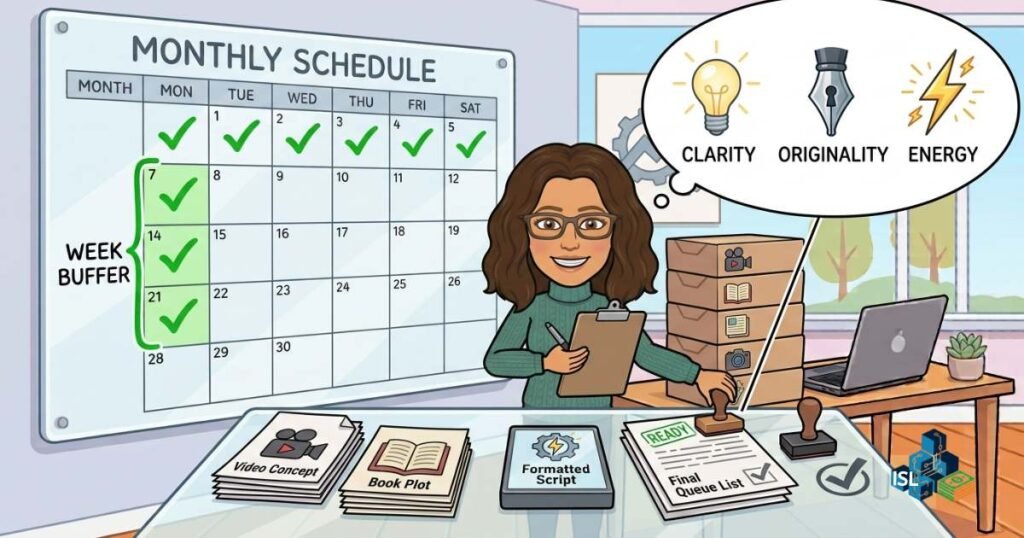
Sustainable batching separates the mechanical work from the human work instead of blending everything into one giant pass. That single change protects your voice, keeps quality intact, and still saves real, meaningful time every single week without any extra software.
Start with a simple rule: AI for logistics, never for the parts that carry your voice.

Where AI Content Batching Belongs (and Where It Doesn't)
Let AI handle research, transcription, keyword suggestions, and first-draft structure, the parts nobody actually watches for or even notices. Keep the final script, the personal story, and the on-camera delivery entirely yours, since that’s what readers genuinely connect with and remember.
- Logistics layer (AI-friendly): outlining, transcribing, summarizing data, suggesting titles, drafting first passes
- Voice layer (human-only): the final script, personal anecdotes, direct replies to comments, on-camera delivery
- Review layer (non-negotiable): a weekly pass checking tone, originality, and whether the post still sounds like you
Tools like Motion or Reclaim AI can protect that review time by blocking it directly on your calendar, so it doesn’t quietly get skipped when the week gets busy.
The Authenticity Test Before You Hit Publish
Before scheduling anything, ask one honest question: could a robot have made this exact piece, start to finish, without any input from you at all? If the answer is yes, it isn’t ready to publish yet, no matter how polished it looks on the calendar.
Go back and add a genuine opinion, a specific detail from your week, or an insight only your experience could produce. This single habit is the fastest fix for content that feels technically fine but oddly hollow.
According to HubSpot, creator burnout tied to posting pressure is a recurring theme across marketing research, with diminishing returns once frequency outpaces audience attention.
What's a Realistic Content Queue Length?
Most solo creators land somewhere between two and four weeks of buffered content without losing their voice or their motivation along the way. That range balances consistency against review fatigue better than a single, sprawling monthly batch ever does.
A simple ceiling worth testing: three to four high-quality posts per week rather than a relentless daily grind. It’s usually better to publish three posts people genuinely enjoy than seven they scroll past.
If you run a newsletter alongside your video content, tools like Beehiiv or Kit let you schedule sends without locking you into a queue so long you lose track of what you actually said.
Signs You've Overdone Your Automated Content Workflow
A queue that’s grown past what you can actually manage tends to announce itself in small, easy-to-ignore ways long before engagement or view counts ever drop noticeably. Watch for these warning signs before the whole system quietly turns against you and your motivation:
- You skip your own review pass because the queue “already looks done”
- Replying to comments feels like a chore instead of a conversation
- You need new tools just to manage the tools you already adopted
- You catch yourself asking whether a post still sounds like you
- Engagement holds steady, but you feel disconnected from your own content
Any one of these on its own isn’t alarming. Several at once usually means the queue has grown past what you can actually stand behind.
A Simple Action Plan for Sustainable Batching
Start smaller than you think you need to, especially in the first month of trying any batching workflow at all. A two-week buffer with a genuine, unhurried review pass beats a 60-day queue you never revisit, question, or fully trust.
- Batch drafts and outlines with AI in one sitting
- Keep templates consistent so formatting doesn’t eat review time
- Run a weekly human pass for tone, originality, and usefulness
- Only schedule what you’d still stand behind after seven days
- Reassess the buffer length monthly as your workload shifts
A tool like Canva can round out this layer, handling graphics quickly so your actual review time stays protected instead of getting quietly absorbed by everything else.
The goal was never autopilot forever. It’s sustainable leverage, where AI content batching handles the heavy lifting while judgment, taste, and final say stay with you.
The Real Problem With Picking the "Best" Tool
Most comparisons rank tools like there’s one universal winner. There isn’t.
In fact, small business and creator decisions are highly context-dependent — a tool’s value is determined by fit, not features alone. That principle applies directly here. ConvertKit at 500 subscribers is overkill. Mailchimp for a solo newsletter is like using a truck to run errands. The “best” tool is always a function of your current stage, your monetization model, and how much complexity you can realistically manage alongside everything else you’re doing.
What matters more than the platform: starting. Switching tools later is easier than most people think. The list you build is portable. The relationships you build with subscribers are not platform-dependent.
FREE 5-Day Challenge
Build Momentum Without the Tech Overwhelm
If you want a structured way to move forward, I’ve put together a free 5-Day Challenge: Build a Sellable Digital Product in 5 days. It focuses on simple, actionable steps without overwhelming tech.
This challenge helps you move past the “I need to figure out hosting first” barrier and actually create something valuable.
Frequently Asked Questions
How many days of content can you realistically queue before AI batching backfires?
Most solo creators can sustain roughly two to four weeks of queued content without losing quality or motivation. Pushing past that range usually trades short-term efficiency for review fatigue and a flatter, less personal voice.
Is batching your content with AI bad for quality?
Not inherently, but unchecked volume is. Batching content with AI only hurts quality when the review layer disappears and posts get scheduled the moment they’re technically finished rather than genuinely good.
What's the difference between batching and full automation?
Batching means drafting and scheduling content ahead of time while a human still reviews every piece before it goes live. Full automation skips that review step entirely, which is where most of the burnout and voice drift actually starts.
How do you know if your content queue is too long?
Watch for skipped review passes, generic comment replies, and a nagging sense that recent posts don’t sound like you anymore. Any one of these alone is minor, but several together signal the queue has outgrown your capacity.
Can AI tools help with content batching without causing burnout?
Yes, as long as AI stays in the logistics layer, handling research, transcription, and first drafts, while your final script, story, and delivery stay entirely human. That boundary is what keeps a queue sustainable instead of hollow.
How often should you review a batched content queue?
A weekly review pass is usually enough to catch tone drift, weak hooks, or repetitive phrasing before they reach your audience. Skipping that pass, even for a single week, is often where quality starts to slip.
Is This Worth It?
Batching your content with AI genuinely saves time on the mechanical side of content creation, and for busy creators juggling a job or family, that time matters. But it isn’t a shortcut around doing the creative work, only a way to spend less time on the parts that never needed your full attention anyway.
The honest trade-off is this: batching buys you consistency, not inspiration. If you keep a weekly review pass and a sensible buffer length, it can genuinely lighten your workload without hollowing out your voice. Skip that discipline, and the same system that promised freedom quietly starts running you instead.
⚠️ Affiliate Disclosure: This post contains affiliate links to tools we have tested or would genuinely use ourselves. If you sign up through our links, we may earn a small commission at no extra cost to you.
Start Your Income Stack Today
📝 Download the free Income Stack Starter Checklist — the PDF helps you choose one realistic income stack and take your first step this week. No overwhelm. No guessing. Just a clear action plan.
Stop searching, start building. Get ready to take the FREE 5-Day Digital Product Challenge. This challenge helps you move past the “I need to figure out hosting first” barrier and actually create something valuable.
🎯 Want the best insights delivered straight to your inbox, subscribe to our weekly newsletter — no spam, just weekly actionable strategies to help you grow your income stack.
Want more? Here is where to find us:
If this resonated with you, come join the community across all our platforms. Subscribe to our YouTube channel ‘The Income Stack Lab’ for weekly videos on AI tools, automation workflows, and income experiments. Follow us on X, Instagram, TikTok, LinkedIn and Facebook for bite-sized tips, behind-the-scenes updates, and daily inspiration to keep building.
Enjoying the content? Buy me a coffee— fuel the lab, keep the ideas flowing.
Your future self will thank you for starting today. Happy Stacking!