
Productize Freelance Work: 3 Steps to Escape the Time Trap
⏱️ Estimated Reading Time: 8 minutes
Learn how to productize freelance work into templates and digital products for steadier, semi-passive income streams. Start today!
It’s Saturday afternoon and you’re still answering client emails instead of relaxing. You’ve landed more freelance work than ever, yet the money and the free time both feel further away. That’s the time-for-money trap: every project pays once, then disappears. If you want to productize freelance work you deliver, the fix isn’t more clients or higher rates. Learning to productize freelance work starts with what you’ve built, not something new.
The shift is smaller than it sounds. You don’t need a new skill or a big launch. You need the templates and processes already built, packaged into something sellable more than once. This guide shows the system, not a leap.
Heads up: This post contains affiliate links. If you buy through them, we may earn a small commission at no extra cost to you — it helps keep ISL going. We only recommend tools we’d genuinely use ourselves.
The Time-For-Money Trap Nobody Warns You About
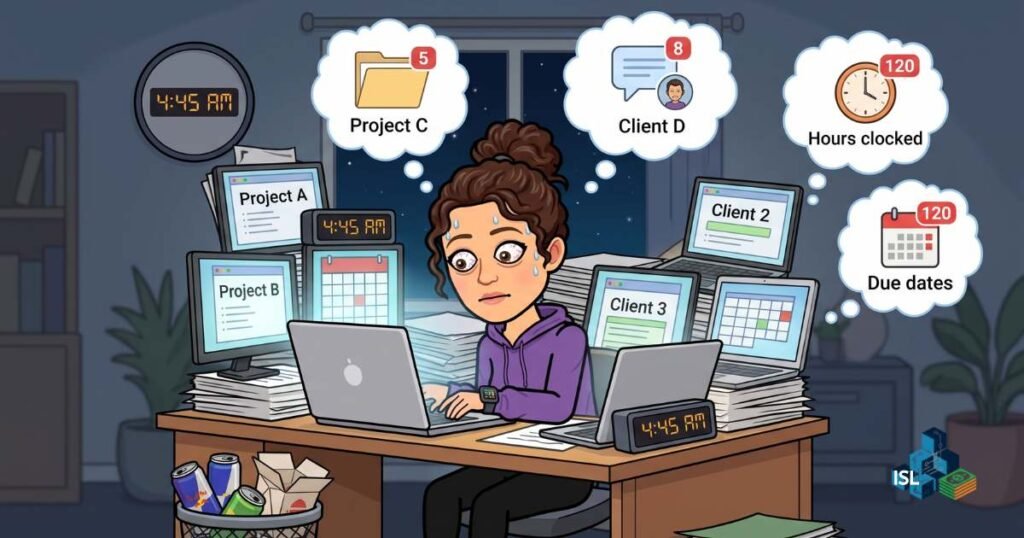
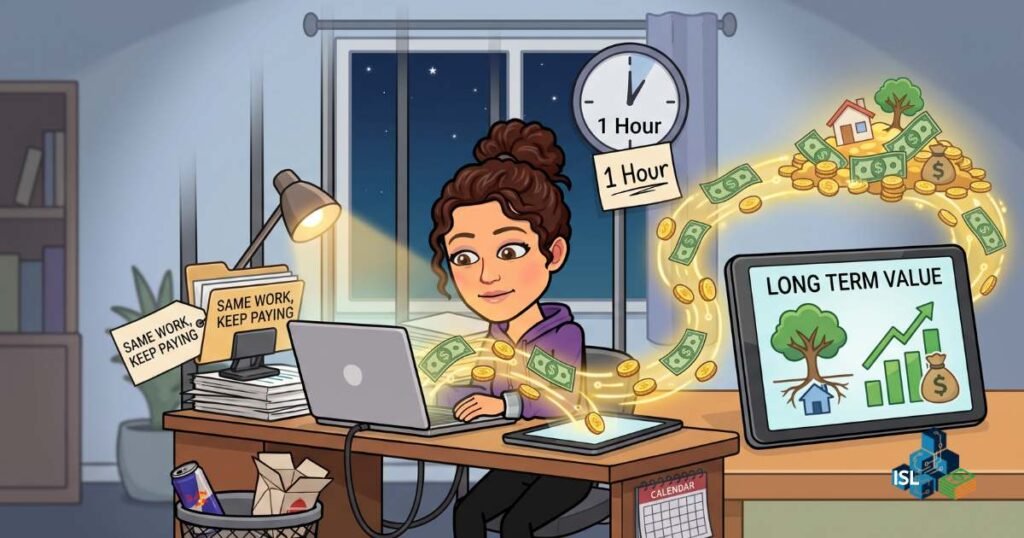
Freelance income is linear by design. More revenue almost always means more billable hours, and the reward for great work is usually just more work. You end up a victim of your own success, feeling more like a worker bee than the architect of your own business.
That instability has a name, and once you see it, you can’t unsee it. You trade hours for dollars, and the moment you stop working, the income slows with you. No amount of skill changes the fact that there are only 24 hours in a day. Raising your rate or chasing more clients can strengthen the bars of that cage instead of removing them — the returns diminish fast.
Most freelancers accept the feast-or-famine cycle as just “how it works.” One month you’re drowning in projects; the next, you’re pitching just to keep the lights on. That’s not freedom. It’s instability with a nicer job title, and it rarely fixes itself without a structural change to how the business runs.
Is Productizing Your Freelance Business Actually Realistic?
Yes, but it requires a mindset shift more than a brand-new skill set. Productized services package your existing expertise into a fixed-scope, fixed-price offer instead of custom work billed hour by hour, and the shift is far more achievable than most freelancers assume once they map it out.
Think of a freelance chef versus a restaurant. The chef cooks anything a client wants, from scratch, every time. A restaurant has a menu — a refined set of dishes, systemized production, and a predictable result for every customer. That’s the pivot: from laying bricks one at a time to designing a repeatable blueprint.
This doesn’t mean abandoning client work. It means reducing reliance on fully custom projects by selling a pre-built solution alongside your time. Revenue potential can grow with less added effort per sale, since income isn’t tied one-to-one to your hours anymore. Results still depend on demand, execution, and market fit — this isn’t a guaranteed outcome.
Model | Revenue Ties To | Scalability | Setup Effort |
Custom freelance work | Hours billed | Low — capped by your calendar | None ongoing |
Productized service | Standardized system | Moderate — some ongoing delivery | Front-loaded, one-time |
Digital product/template | Sales volume | High — sell without rebuilding | Front-loaded, plus maintenance |
Start this week. Take one action.
Download the free Income Stack Starter Checklist — the PDF helps you choose one realistic income stack and take your first step this week. No overwhelm. No guessing. Just a clear action plan.
The Three-Phase Framework to Productize Freelance Work
Turning client work into a sellable system comes down to three phases: Identify, Systematize, and Validate. None of them are set-it-and-forget-it — each requires real testing and iteration before the offer holds up under actual buyer demand rather than assumptions about what people want.
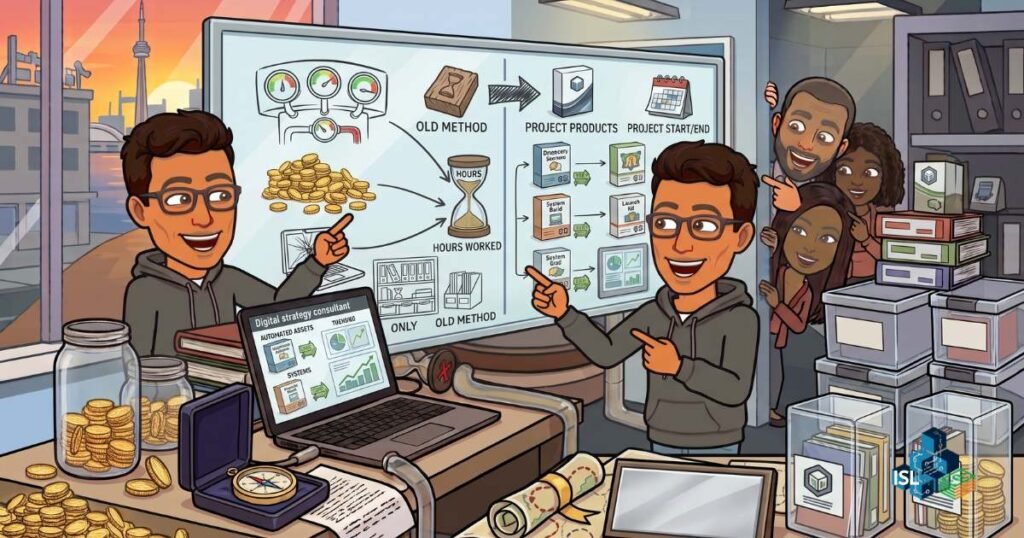
Phase 1: Identify Your Repeatable Core
Look back at your last 10 to 20 clients. What deliverable did they request repeatedly? What templates or checklists did you keep remaking from scratch? Where those answers overlap is your opportunity.
Instead of “web design,” maybe your repeatable core is a “5-Page Starter Website for Service Businesses.” Instead of “copywriting,” maybe it’s a “Monthly SEO Blog Post Package.” Ask yourself which service you could imagine delivering ten times in a row without dreading it — that predictability is what makes something productizable.
Phase 2: Systematize and Package Your Expertise
A product is really just a documented system. Map every step from the moment a client says yes to final delivery: intake forms, email templates, project checklists. If you can’t write a step down clearly, it’s hard to package it.
Once documented, build your offer around three pillars:
- The Promise — a clear scope of what’s included and what isn’t
- The Process — a mapped client journey (Day 1: intake, Day 3: draft, Day 5: delivery)
- The Price — tied to the value delivered, not your old hourly rate
Phase 3: Build and Validate Before You Scale
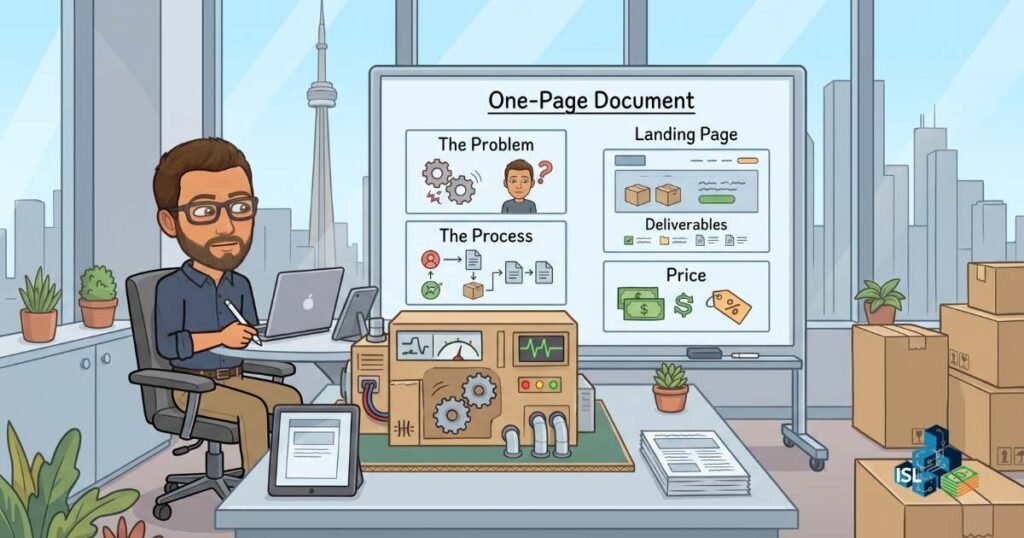
Avoid spending months on an elaborate automated system before testing actual demand. Use a “pre-sell” approach instead: create a one-page outline of the problem, process, deliverables, and price, then reach out to five or ten past clients with a limited-time pilot offer.
Your goal is real-world feedback — that data is far more valuable than a guess. That’s the entire point of the pilot phase: it tells you whether to refine the offer or scrap it before you’ve sunk months into building it.
A Mini Case Study: From Client Deliverable to Digital Product
A freelance web developer noticed she’d rebuilt the same configuration script for six different clients over the course of a year. She stripped out the client-specific details, packaged the result as a downloadable template, and listed it for sale on Gumroad alongside her regular client work.
Results here are illustrative, not typical — outcomes depend heavily on niche, marketing, and execution. But the pattern holds: nothing was built from scratch. It came from work that already existed in her client files.
How to Package a Product Without Losing Months to Perfectionism
Getting a productized offer to market doesn’t require a fancy build or months of development time. A simple five-step approach keeps momentum going without overbuilding, so you can test real demand before investing serious time or money into the finished system.
- Find the pattern. Review your last 10–20 projects for anything you’ve built more than twice — SOPs, pricing sheets, content calendars, contract templates.
- Strip out client-specific details. Remove names, brand colors, and custom data so what remains is a reusable framework.
- Choose the right format. Some processes fit a Canva template pack; others suit a spreadsheet tool, swipe file, or short workshop.
- Price it on value, not old habits. Freelancers often underprice knowledge out of habit from charging for time — a well-packaged template can reach more buyers at a lower unit price, though results vary by niche.
- Sell it alongside your services, not instead of them. Client projects can continue feeding your product pipeline over time.
The Light Tool Layer: What You Actually Need to Start
You don’t need an elaborate tech stack to productize freelance work at this early stage. A simple landing page builder, an email tool for delivery, and a marketplace like Etsy or Gumroad cover most first launches without added software costs.
Diversifying income sources is one factor that can support household financial resilience over time — though it’s not a substitute for an emergency fund or sound budgeting. Pairing a productized offer with basic bookkeeping keeps the numbers honest from day one.
What's a Realistic Timeline for This Shift?
There’s no fixed number of weeks that applies to everyone, and anyone promising one is overselling it. Identifying your repeatable core might take a single afternoon of reviewing past projects. Documenting the system and running a client pilot typically takes longer, depending on your availability.
The point isn’t speed — it’s sequencing. Validate before you build, and build before you scale. Skipping steps to move faster is usually what causes freelancers to abandon a productized offer before it ever gets tested properly.
Simple Action Plan for This Week
This week’s plan focuses on identifying and testing, not building the whole system. Each step below should take a few focused hours rather than a full weekend, so it fits around your existing client workload instead of competing with it.
- Review your last 10–20 client projects and circle anything repeated three or more times
- Strip one recurring deliverable down to a reusable, client-agnostic version
- Draft a one-page pre-sell outline: problem, process, deliverables, price
- Reach out to 5–10 past clients with a limited-time pilot offer
- Track responses in a simple spreadsheet before committing to a full build
Common Mistakes That Undermine a Productized Offer
Three mistakes show up again and again. First, freelancers try to build the “perfect” product before validating demand instead of testing a rough version with existing clients. Second, they price based on their old hourly rate rather than the ongoing value delivered.
Third, they treat the launch as separate from their freelance brand, when existing clients are usually the first and warmest buyers. Trust built with an existing audience tends to convert into early sales more reliably than reaching cold, unfamiliar traffic.
FREE 5-Day Challenge
Build Momentum Without the Tech Overwhelm
If you want a structured way to move forward, I’ve put together a free 5-Day Challenge: Build a Sellable Digital Product in 5 days. It focuses on simple, actionable steps without overwhelming tech.
This challenge helps you move past the “I need to figure out hosting first” barrier and actually create something valuable.
Frequently Asked Questions
What does it mean to productize freelance work?
It means packaging your repeatable skills, templates, and processes into a fixed-scope, fixed-price offer instead of billing purely by the hour. The goal is a sellable system, not a one-off custom project.
Do I have to stop taking freelance clients to do this?
No. Most freelancers layer a productized offer alongside existing client work rather than replacing it. Client projects can even continue feeding your product pipeline with new ideas over time.
How do I know if my service is productizable?
Look for deliverables you’ve repeated across multiple clients with minimal customization. If you can imagine delivering the same core process ten times without dreading it, it’s a strong candidate.
What's the fastest way to validate a productized offer?
A pre-sell approach works well: outline the offer on one page and pitch a limited-time pilot to 5–10 past clients before building anything elaborate. Real signups are more reliable than guesses.
Can I productize freelance work without technical skills?
Yes. Many first offers are simple templates, checklists, or Canva packs rather than complex software. The format should match how quickly a buyer gets value, not your technical ability.
How much income can a productized service realistically add?
There’s no guaranteed number, and results vary by niche, audience, and execution. Some freelancers see it as a modest supplemental stream; others build it into a larger part of their business over time.
Is This Worth It?
Productizing your freelance work isn’t a shortcut, and it won’t replace solid client relationships overnight. It takes real time upfront to document a system, test it with a pilot, and refine based on what actually sells.
That said, the underlying logic holds up: the value in your business often already exists in the templates and processes you’ve built, not just in your remaining hours. For freelancers stuck in the feast-or-famine cycle, testing one small productized offer costs little more than a few pilot conversations and an afternoon of documentation. Whether it becomes a meaningful second stream depends on your niche, your existing client relationships, and how consistently you follow through after the pilot phase.
⚠️ Affiliate Disclosure: This post contains affiliate links to tools we have tested or would genuinely use ourselves. If you sign up through our links, we may earn a small commission at no extra cost to you.
Start Your Income Stack Today
📝 Download the free Income Stack Starter Checklist — the PDF helps you choose one realistic income stack and take your first step this week. No overwhelm. No guessing. Just a clear action plan.
Stop searching, start building. Get ready to take the FREE 5-Day Digital Product Challenge. This challenge helps you move past the “I need to figure out hosting first” barrier and actually create something valuable.
🎯 Want the best insights delivered straight to your inbox, subscribe to our weekly newsletter — no spam, just weekly actionable strategies to help you grow your income stack.
Want more? Here is where to find us:
If this resonated with you, come join the community across all our platforms. Subscribe to our YouTube channel ‘The Income Stack Lab’ for weekly videos on AI tools, automation workflows, and income experiments. Follow us on X, Instagram, TikTok, LinkedIn and Facebook for bite-sized tips, behind-the-scenes updates, and daily inspiration to keep building.
Enjoying the content? Buy me a coffee— fuel the lab, keep the ideas flowing.
Your future self will thank you for starting today. Happy Stacking!