
Replace 20% of Your Salary in 12 Months: A Realistic Plan
⏱️ Estimated Reading Time: 9 minutes
Learn how to replace 20% of your salary in 12 months with simple AI tools and a realistic monthly roadmap. Start your stack today!
It’s a quiet Saturday morning, coffee still warm, laptop open on the kitchen table. You’re scrolling your bank balance, doing math you’ve run a dozen times: one paycheck, one employer, one real risk. You’re not unhappy at work. You just know that if your only income vanished tomorrow, your options would shrink fast. That’s exactly why you, like so many other professionals, need to replace 20% of your salary instead of chasing some unrealistic full-income overhaul. It’s a smaller, steadier target than most expect.
Working to replace 20% of your salary isn’t about quitting your job or chasing a moonshot. It’s one automated income layer, built with simple tools, over twelve steady months.
Heads up: This post contains affiliate links. If you buy through them, we may earn a small commission at no extra cost to you — it helps keep ISL going. We only recommend tools we’d genuinely use ourselves.
How to Replace 20% of Your Salary Without Quitting Your Job
Most online advice skips straight to quitting your job. That’s not what this is. A partial target survives real life — bills, a mortgage, health insurance — far better than a full overhaul does.
A full income overhaul sounds exciting but rarely survives contact with real life — bills, a mortgage, kids, health insurance. A partial target does. Income diversification doesn’t require you to burn the boat; it just requires one working layer next to your day job.
That’s the real case for choosing to replace 20% of your salary as a first goal, rather than a stretch goal you’ll likely abandon by month three.
For someone earning $75,000 a year, a 20% target works out to roughly $1,250 a month. That’s not life-changing on its own. But it’s a buffer — the kind that means one slow month at the day job stops being a crisis and starts being an inconvenience. Once you’ve built a system to get there, scaling it further becomes a known path instead of a guess.
A few years ago, building any meaningful side income required serious upfront capital, a specialized skill set, or both. That barrier has dropped. AI tools now compress tasks that used to take a freelancer hours — drafting, editing, basic design, simple automation — into minutes, which means the gap between “I have an idea” and “I have a working offer” is shorter than it’s ever been. The tools don’t do the work for you, but they remove a lot of the friction that used to stop people before they started.
How to Build a Second Income Stream Without Burning Out
Pick one path, learn its core tools, give it a few focused hours a week — that’s the entire blueprint. Most people fail by running three paths at once.
Pick one path, learn its core tools, and give it a few focused hours a week — that’s the entire blueprint. The mistake most people make is trying three income paths at once and finishing none of them.
“Complexity kills momentum when you’re already working full-time.” — a pattern that shows up across nearly every income-stack experiment we’ve run.
A side income plan only works if it fits inside the hours you actually have, not the hours you wish you had. Ten focused hours a week, applied consistently for months, outperforms forty scattered hours applied once.
This is also the stage where most people overthink the decision. You don’t need a business plan to start working toward a 20% income target — you need a single offer, posted somewhere real, this week.
Start this week. Take one action.
Download the free Income Stack Starter Checklist — the PDF helps you choose one realistic income stack and take your first step this week. No overwhelm. No guessing. Just a clear action plan.
The 3 Income Paths Busy Professionals Are Actually Using in 2026
Each path below suits a different mix of time, skill, and risk tolerance. None requires a business degree or a five-figure investment to start.
Path 1 — AI-Powered Services
This is the fastest route to a first dollar. You use AI tools to deliver a service businesses already pay for, faster than a generalist freelancer could.
Claude and ChatGPT speed up the writing and client communication side, while Canva AI handles visual deliverables. Common entry points include AI-assisted content for small businesses, resume and LinkedIn optimization, simple chatbot setup, and podcast repurposing using tools like Descript or OpusClip.
You don’t need to offer all four service types. Pick one, land two clients, and refine from there.
Pricing is where most beginners hesitate. A resume rewrite using AI-assisted tools commonly runs $40–$150 per engagement, while a basic chatbot setup for a local business can be billed hourly or as a flat project fee. Neither requires a portfolio built over years — a handful of solid sample pieces is usually enough to start pitching.
Service Path at a Glance
Service | Typical Engagement | Core Tool |
AI content for small businesses | Monthly retainer | Claude or ChatGPT |
Resume / LinkedIn optimization | Per-project | Claude + Canva AI |
Chatbot setup for local businesses | Hourly or flat fee | Make or Zapier |
Podcast repurposing | Monthly retainer | Descript or OpusClip |

Path 2 — Digital Products
If services trade your time for money, digital products loosen that trade-off — though “passive” undersells the early effort. Building a listing, testing pricing, and getting initial traffic all take real work upfront.
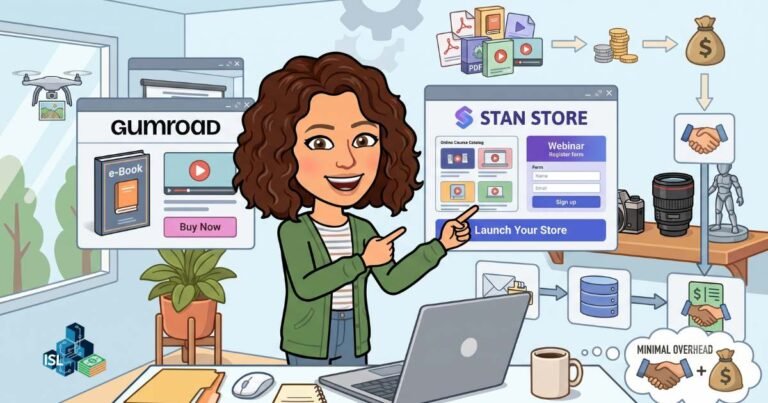
Your 9-to-5 expertise is often the product. Someone in finance, HR, marketing, or operations already has knowledge other professionals would pay to shortcut. Tools like Gumroad or Stan Store handle the selling infrastructure with minimal overhead.
The honest version of this path looks slower at first than people expect. Outlining and designing a single template might take a weekend. Getting that listing noticed, refined, and reordered based on buyer feedback can take several months — which is exactly why digital products work better as a second or third stack layer than a first one for most people.
Path 3 — AI Automation Consulting
This path has the highest hourly ceiling but the steepest learning curve. You’re helping small businesses streamline repetitive work using tools like Make or Zapier.
Most business owners know they need to automate. They just don’t know where to start — which is exactly the gap this path fills.
Both Make and Zapier offer free tiers, visual drag-and-drop builders, and large tutorial libraries, so the entry barrier is lower than it looks. Reaching a genuinely billable skill level usually takes a few focused weekends rather than months, though commanding premium hourly rates still depends on real client experience.
Is a 12-Month Income Roadmap Realistic?
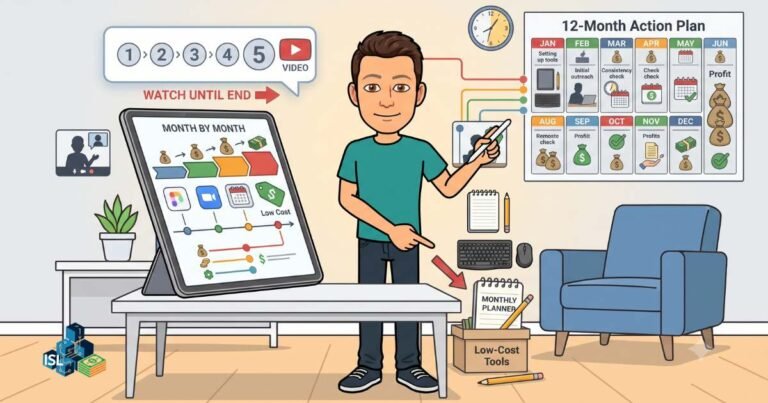
A 12-month roadmap is realistic if you treat the first three months as setup, not income. Early traction typically shows up in months four to six, not before. Most of the early work is invisible — profile, tools, first offer — and it rarely pays in month one. Professionals who stick with the plan to replace 20% of your salary tend to see the first real traction between months four and six, not before.
Phase | Focus | Realistic Milestone |
Months 1–3 | Foundation | First client or first sale |
Months 4–6 | Refine | ~50% of your target income |
Months 7–9 | Scale | Recurring clients or steady listings |
Months 10–12 | Systemize | Approaching your 20% target |
Mini Case Study: An HR Manager's 9-Month Build
A mid-level HR manager earning around $72,000 started Path 2, packaging interview-prep templates using digital product tools. Months one and two produced exactly one sale. By month seven, consistent listing tweaks and a small email list brought monthly revenue close to $900 — short of the full target, but a real, working buffer with room to keep growing.
What changed between month two and month seven wasn’t a single breakthrough. It was a dozen small adjustments — better product photos, a clearer title, an email sequence built with Claude — none of which felt significant on its own.
Tools Worth Knowing Before You Start
Tool | Best For | Free Tier? |
Claude | Writing, client communication | Yes |
Canva AI | Design and visuals | Yes |
Descript/OpusClip | Audio/video editing | Yes |
Make | Workflow automation | Yes |
Gumroad | Selling digital products | Yes |
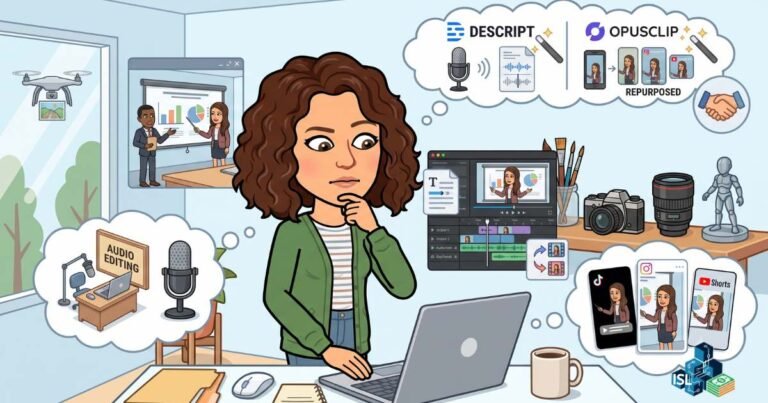
Most of these tools have usable free tiers, so your cash outlay stays low. Your real cost is the time spent learning each one — factor that in honestly, not just the dollar signs.
A practical rule: don’t add a new tool until the one you’re using is genuinely limiting you. Stacking five tools before you’ve landed your first client or sale usually slows you down rather than speeding you up.
According to Upwork’s research on freelance trends, demand for AI-assisted freelance skills has grown steadily, with rates varying widely by niche and experience level. That demand is exactly what makes path 1 viable for someone starting from zero.
The Mistakes That Quietly Kill an Income Stack Plan

Trying too many paths at once
It is the most common one. Pick one stream, one audience, and resist the urge to diversify before you’ve validated anything.
Expecting Income In Week One
Keep in mind that building any new income source takes sustained effort over months, not days, which matches what most income-stack builders report.
Underpricing Your Own Skills
Check what comparable freelancers charge on Upwork and other platforms before settling on a rate out of self-doubt rather than market data.
Building Without Automating
If every task is manual, growth caps out fast. Bring automation workflows in early instead of bolting them on after burnout sets in.
Comparing With Others
There’s one more mistake worth naming: comparing month two of your stack to month twenty of someone else’s. Most of the income-stack stories you see online have already survived the slow, unglamorous early phase — the part that almost never makes it into a highlight reel.
FREE 5-Day Challenge
Build Momentum Without the Tech Overwhelm
If you want a structured way to move forward, I’ve put together a free 5-Day Challenge: Build a Sellable Digital Product in 5 days. It focuses on simple, actionable steps without overwhelming tech.
This challenge helps you move past the “I need to figure out hosting first” barrier and actually create something valuable.
Frequently Asked Questions
How long does it take to replace 20% of your salary?
Most professionals following a structured plan see early traction by month four to six, with the full target approached closer to month ten or twelve. The timeline depends heavily on your chosen path, skills, and consistency.
What's the easiest income path for a complete beginner?
AI-powered services tend to produce a first dollar fastest, since they rely on tools you can learn in a weekend rather than building an audience from scratch.
Do I need to quit my job to build a second income stream?
No. This approach is built specifically around keeping your day job while building one income layer alongside it, using 5–10 focused hours a week.
How much money do I need to start?
Very little. Most of the tools mentioned here — Claude, Canva AI, Make, and Gumroad — offer functional free tiers, so your main investment is time rather than cash.
Is it realistic to replace 20% of your salary with digital products alone?
It’s possible, but digital products usually take longer to gain traction than services, since they depend on consistent traffic and listing optimization rather than direct outreach.
What's the biggest reason people fail at this?
Trying to run two or three income paths at once. Picking one path and giving it real focus consistently outperforms splitting attention across several half-built ideas.
Is This Worth It?
Building toward a 20% income target takes real hours, not magic. Some months will produce almost nothing, especially the first three. If you’re hoping for fast, guaranteed results, this isn’t that.
What it does offer is a tested structure: one path, simple tools, and a realistic twelve-month window instead of a vague someday. For a busy professional with five to ten spare hours a week, that’s a genuinely reasonable trade — a financial buffer built on your own terms, without betting your entire income on one employer.
⚠️ Affiliate Disclosure: This post contains affiliate links to tools we have tested or would genuinely use ourselves. If you sign up through our links, we may earn a small commission at no extra cost to you.
Start Your Income Stack Today
📝 Download the free Income Stack Starter Checklist — the PDF helps you choose one realistic income stack and take your first step this week. No overwhelm. No guessing. Just a clear action plan.
Stop searching, start building. Get ready to take the FREE 5-Day Digital Product Challenge. This challenge helps you move past the “I need to figure out hosting first” barrier and actually create something valuable.
🎯 Want the best insights delivered straight to your inbox, subscribe to our weekly newsletter — no spam, just weekly actionable strategies to help you grow your income stack.
Want more? Here is where to find us:
If this resonated with you, come join the community across all our platforms. Subscribe to our YouTube channel ‘The Income Stack Lab’ for weekly videos on AI tools, automation workflows, and income experiments. Follow us on X, Instagram, TikTok, LinkedIn and Facebook for bite-sized tips, behind-the-scenes updates, and daily inspiration to keep building.
Enjoying the content? Buy me a coffee— fuel the lab, keep the ideas flowing.
Your future self will thank you for starting today. Happy Stacking!