
What Is an AI Agent? 4 Definitions, 1 Test | ISL
⏱️ Estimated Reading Time: 11 minutes
What is an AI agent? Four groups use the word for four different things. Compare all four, then use one question to test any product.
TL;DR
There is no single definition of "AI agent." Four are in live use, written by four different groups, and they do not agree. The academic one is wide enough to include a thermostat. OpenAI's own guide excludes chatbots. Salesforce prices an agent as a billing unit. The A2A standard defines one as a web address that needs no intelligence at all. A product can satisfy one and fail the other three, so the word on the sales page tells you almost nothing. One question sorts them: who decides the next step?
A thermostat meets the official definition of an AI agent.
That is not a joke. Open the standard artificial intelligence textbook and an agent is defined as anything that perceives its environment through sensors and acts on that environment through actuators. A home thermostat reads the temperature. It switches the heat. Sensor, actuator. It qualifies. So when a sales page says a product is an AI agent, that sentence on its own carries almost no information.
The word has split. Four separate definitions are in use right now, written by four different groups of people, and they contradict each other in public. This matters because the label is about to be everywhere: Gartner predicts that 40% of enterprise applications will ship with task-specific AI agents by the end of 2026, up from under 5% in 2025. When a word goes on everything, it stops meaning anything, and the cost lands on whoever is choosing the tool and paying the subscription.
What is an AI agent?
An AI agent has four competing definitions, not one. The academic definition is any system that perceives its environment and acts on it. The architectural definition is a system where the language model chooses its own next step. The product definition is a unit that gets metered and billed. The network definition is a server publishing a capability document at a web address.
Those are not four flavours of one idea. They are four different questions, written by four groups with different jobs: researchers who needed a wide category, AI labs who needed a narrow engineering line, vendors who needed something countable on an invoice, and a standards body that needed an address format. None of them is lying. Each is answering its own question, and nothing on a product page says which question is being answered. The table below is the whole argument in one place.
| Definition | Written by | The test it applies | Does a thermostat pass? | Does a chatbot pass? |
|---|---|---|---|---|
| Textbook | Academic AI, Russell & Norvig lineage | Does it perceive through sensors and act through actuators? | Yes — named as a simple reflex agent | Yes |
| Architecture | Anthropic and OpenAI engineering guides | Does the model direct its own process and tool use? | No — the steps are fixed in advance | No — OpenAI's guide names chatbots as not agents |
| Product | Vendor pricing and marketing teams | Is there a meter counting actions or conversations? | No — nothing is being billed | Yes, whenever the vendor meters it |
| Network | A2A Protocol, under the Linux Foundation | Does it publish a valid Agent Card and answer when called? | Only if someone wraps it in a server | Only if someone wraps it in a server |
Each definition is quoted from its publisher's own page. Every page was opened and checked in October 2026.

🎬 Watch the full video breakdown below
Definition 1: the textbook agent, and why a thermostat counts
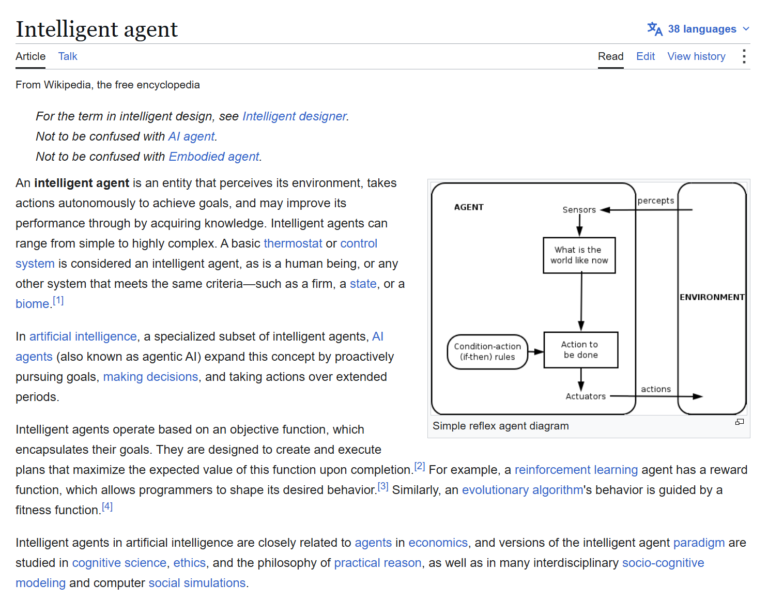
In academic artificial intelligence, an agent is anything that perceives its environment and acts on it. That is the entire definition. A rational agent picks the action that best serves its goal given what it has seen and what it can do. Under that definition, spam filters, aircraft autopilots, chess programs from the nineties and home thermostats are all agents.
The word predates large language models by decades, and the standard reference literature gives the thermostat as the worked example of a simple reflex agent — it reads one input and fires one rule. This is the definition that lets anyone claim anything. When a vendor gets challenged on whether a product is really an agent, this is the floor they retreat to, and technically they are right. A script that reads an inbox and files an email perceives and acts. Academically, that is an agent.
So the textbook meaning is true and close to useless for a buying decision. It is the floor, not the bar.
Definition 2: what is the difference between a workflow and an AI agent?
A workflow is a system where a person decided the steps in advance and the language model fills in the blanks. An agent is a system where the model decides the steps itself, in the moment, based on what just happened. That single difference — who chose the sequence — is the architectural definition, and it is the strictest one in common use.
Anthropic's engineering post "Building effective agents" draws the line explicitly: workflows are systems where language models and tools are orchestrated through predefined code paths, while agents are systems where the models dynamically direct their own processes and tool usage, keeping control over how the task gets done. The same page opens by admitting the word "can be defined in several ways" — which is the argument of this article, written by one of the companies building the things.

Does a chatbot count as an AI agent?
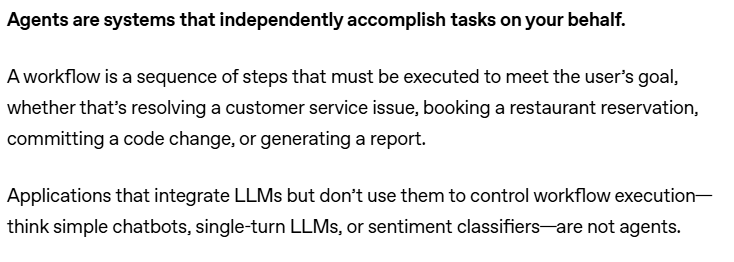
Under the architectural definition, no. OpenAI's own practical guide to building AI agents states it plainly: applications that integrate language models but do not use them to control workflow execution — simple chatbots, single-turn models, sentiment classifiers — are not agents.
That sentence is worth sitting with. The company selling the most famous chatbot on earth published a document saying chatbots are not agents. Under the textbook definition from the previous section, the same chatbot passes easily. Two definitions, two opposite answers, both from credible sources, neither of them wrong.
Start this week. Take one action.
Open the FREE ISL Resource Vault. It holds every free guide, checklist and template from the lab in one place. Pick one resource. Build one system this week. No overwhelm. No guessing.
Definition 3: the product agent is a billing unit
The third meaning almost nobody states out loud, because it is not really a definition. It is a unit of measurement for an invoice. Look at how agents get priced and the shape becomes obvious.
Salesforce sells Agentforce, and on its own pricing page an agent is metered. Flex Credits run at $500 per 100,000 credits, and every action an agent takes draws 20 of them — voice actions draw 30. On top of that sits a $5 per user per month licence, with add-ons at $125 and $150 per user per month and Max Editions from $550 per user per month. The Conversations plan sitting beside it no longer shows a price at all; it reads "contact us."
Notice what is being counted. Not decisions. Not tasks completed. Not autonomy of any kind. Actions and credits. In the product sense, an agent is a meter.

Zapier makes the blur even easier to see, because one company sells both things on one login. Zapier's core product is Zaps — predefined steps, which is the textbook example of a workflow under the architectural definition above. Its pricing page gives the free plan 100 tasks a month, with paid plans from $19.99 a month. Beside that, Zapier sells Agents on a separate meter, with a free tier of 400 runs a month.
Same company, same login, two products. One is a workflow and one is called an agent, and the clearest thing separating them on the page is how they get counted. This is the meaning most people actually run into, and the one most likely to mislead, because the word on the invoice was chosen by a marketing team rather than an engineering one.
Prices checked on each company's own pricing page in October 2026. Subscription pricing changes frequently — confirm on the vendor's page before paying.
Definition 4: what is an Agent Card in the A2A protocol?
An Agent Card is a small structured document published at a web address, stating a system's identity, capabilities, skills, endpoint and how to authenticate against it. In the A2A standard, that card is the definition of an agent: a server that publishes a valid card and answers when called. Nothing in it requires intelligence, and nothing requires a language model.
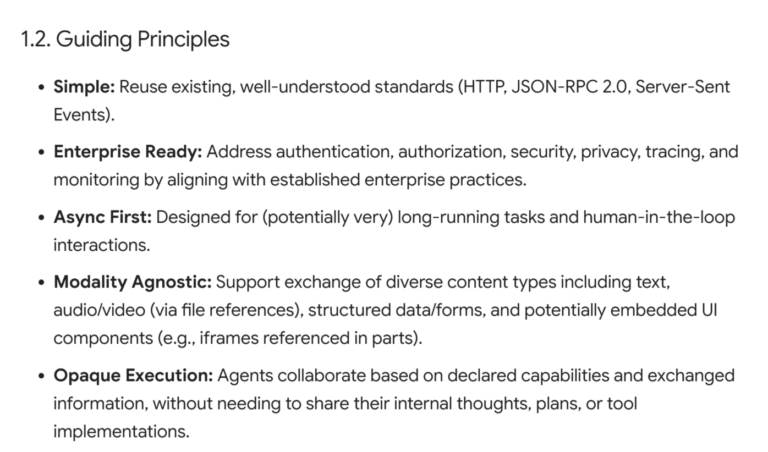
The specification is called A2A — agent to agent. It has reached version 1.0 and sits under the Linux Foundation, and its job is to let AI systems built by different companies call each other. Under this definition a thin wrapper around a database qualifies as an agent. So does a system with no model inside it at all. That sounds like a loophole, and it is not: the specification names it "opaque execution" and treats it as a design goal. Agents cooperate based on what they declare they can do, without exposing how they do it. For getting different companies' software to work together, that is the right call. For a buying decision, it means the badge says nothing about what is underneath.
What is agent washing, and how common is it?
Agent washing is the rebranding of existing products — assistants, robotic process automation, chatbots — as agentic AI without substantial agentic capability. The term comes from Gartner, which put a number beside it: out of the thousands of vendors claiming agentic AI, the firm estimated that only around 130 were the real thing.
That estimate dates from a June 2025 Gartner release, and it is one analyst firm's estimate rather than a census — worth reading as exactly that. The same release predicted that over 40% of agentic AI projects would be cancelled by the end of 2027. Both figures point the same direction, and the direction is hard to argue with: the label is travelling much faster than the capability behind it.
How to tell whether a product is really an agent
When something claims to be an agent, ask one question: who decides the next step?
If the answer is a person who wrote the steps down in advance, it is a workflow. Useful, frequently the right choice, and not an agent under the strict definition. If the answer is the model, in the moment, based on what just happened, it is an agent in the architectural sense — the only one of the four that describes behaviour rather than marketing, billing or plumbing.
Ask it on a sales call and watch what happens. A vendor who built the real thing answers in one sentence. A vendor who did not will reach for the textbook definition, start listing features, or move the conversation to the roadmap.
Four mistakes that cost the most
- Reading the badge as a capability. The word on the page is a category claim, not a behaviour. Four definitions mean four possible things being claimed, and the page rarely says which.
- Treating "autonomous" as a feature list item. Autonomy is the one property that cannot be demonstrated in a feature table. It shows up in how the product behaves when something unexpected happens, which is only visible in a trial.
- Comparing prices across definitions. A per-credit agent meter and a per-task workflow meter are not comparable units. Work out the number of actions a real month contains before comparing any two plans.
- Buying the strict version for a repetitive job. Covered below — this one is the expensive mistake, and it is the opposite of the mistake most buying guides warn about.
Several of these show up again at larger scale once multiple agents are involved, where the failure modes multiply rather than add — ISL has written separately on the ways agent swarms break.
Is a strict autonomous agent always better than a workflow?
No, and chasing the strict architectural definition is often the wrong move. A model that picks its own steps is harder to predict, harder to debug and harder to put a ceiling on. For a great deal of real work — the same twelve steps every Tuesday — a boring workflow breaks less and costs less to run.
Anthropic's own guidance says as much: workflows offer predictability and consistency for well-defined tasks, while agents are the better option where flexibility and model-driven decision-making are genuinely needed. Strict agent is not a synonym for better. Sometimes it is a synonym for expensive. The useful version of this test is not "is it a real agent" but "does this job need one" — and for anything that repeats on a schedule, such as a weekly planning system that survives Tuesday or a single recurring AI workflow, the answer is usually no.
Where the work is genuinely repetitive, the tools worth the setup time tend to be ordinary ones: ISL keeps a running list of free AI tools that give busy people hours back, and a separate comparison of AI scheduling assistants, most of which are workflows wearing the newer label. If the plan is to drive any of this with Claude or ChatGPT directly, the setup matters more than the label — ISL's notes on prompting habits that quietly cost hours cover the part that goes wrong first.

Get One Buildable System Every Week
Want a steady way to keep moving? ISL Weekly is the free Income Stack Lab newsletter. Each issue gives you one AI system you can build, plus the tools that make it work. Short, clear steps. No tech overwhelm.
Frequently asked questions
What is an AI agent in simple terms?
It depends which definition is being used. In the widest, academic sense, an AI agent is any system that senses its environment and acts on it — which includes a thermostat. In the stricter engineering sense now used by Anthropic and OpenAI, an AI agent is a system where a language model chooses its own next step rather than following steps a person wrote in advance.
What is the difference between an AI agent and an AI workflow?
A workflow follows predefined code paths: a person decided the sequence and the model fills in the blanks. An agent dynamically directs its own process and tool use, keeping control of how the task gets done. The difference is who chose the sequence, not how advanced the model is.
Is a chatbot an AI agent?
Under the architectural definition, no. OpenAI's practical guide to building AI agents states that applications which integrate language models but do not use them to control workflow execution — simple chatbots, single-turn models, sentiment classifiers — are not agents. Under the academic definition, the same chatbot does qualify.
Why is a thermostat considered an intelligent agent?
Because the standard academic definition only requires that a system perceive its environment through sensors and act on it through actuators. A thermostat reads the temperature and switches the heat, so it meets that bar. The reference literature uses it as the worked example of a simple reflex agent.
What is agent washing?
Agent washing is the rebranding of existing products — AI assistants, robotic process automation and chatbots — as agentic AI without substantial agentic capability. Gartner named the practice in June 2025 and estimated that only around 130 of the thousands of vendors claiming agentic AI were the real thing.
What is an Agent Card in the A2A protocol?
An Agent Card is a structured document published at a web address that states a system's identity, capabilities, skills, endpoint and authentication requirements. In the A2A standard, publishing a valid card and answering when called is what makes something an agent. No language model is required.
How much does an AI agent cost to run?
It depends entirely on how the vendor meters it, and the units are not comparable between products. Salesforce Agentforce bills Flex Credits at $500 per 100,000 credits, with each agent action drawing 20 credits, plus a $5 per user monthly licence. Zapier Agents offers a free tier of 400 runs a month alongside its separate Zaps plans, which start from $19.99 a month. Work out the number of actions a realistic month contains before comparing any two plans. Prices checked October 2026.
How can you tell if a product is really an AI agent?
Ask who decides the next step. If a person wrote the steps down in advance, it is a workflow. If the model chooses the next step in the moment based on what just happened, it is an agent in the architectural sense. A vendor who built the real thing answers that question in one sentence.
Is this worth it?
Learning the four definitions takes about ten minutes and saves a specific kind of waste: paying agent pricing for workflow behaviour. That is the whole return, and it is real but narrow. It will not tell you whether a given tool is any good, only which category of claim is being made.
The honest limitation is that the test has one answer the marketing never gives you, and some vendors will simply refuse to answer it. It also will not help anyone building agent frameworks — none of this is new at that level. And the test cuts both ways: finding out that a product is "only" a workflow is frequently good news, because a workflow is the better tool for anything that repeats. The word agent tells you almost nothing on its own. The answer to who decides the next step tells you almost everything.
All four definitions, the question that identifies each one, and what each one does and does not tell you about a product sit on one page in The Agent Definition Card, free in the Resource Vault.
Keep Building With the Lab
📂 Grab the free tools. The ISL Resource Vault holds every free guide, checklist and template from the lab. Pick one and start today.
🎯 Get one system a week. Subscribe to ISL Weekly: one buildable AI system in your inbox every week. No spam. Unsubscribe any time.
Want more? Here is where to find us:
Subscribe to Income Stack Lab on YouTube for new videos every week on AI tools, automation builds and honest tool tests. Follow along on X, Instagram, TikTok, LinkedIn and Facebook for quick tips and a look inside the lab.
Enjoying the content? Buy me a coffee— fuel the lab, keep the ideas flowing.
Your future self will thank you for starting today.
Happy Stacking!